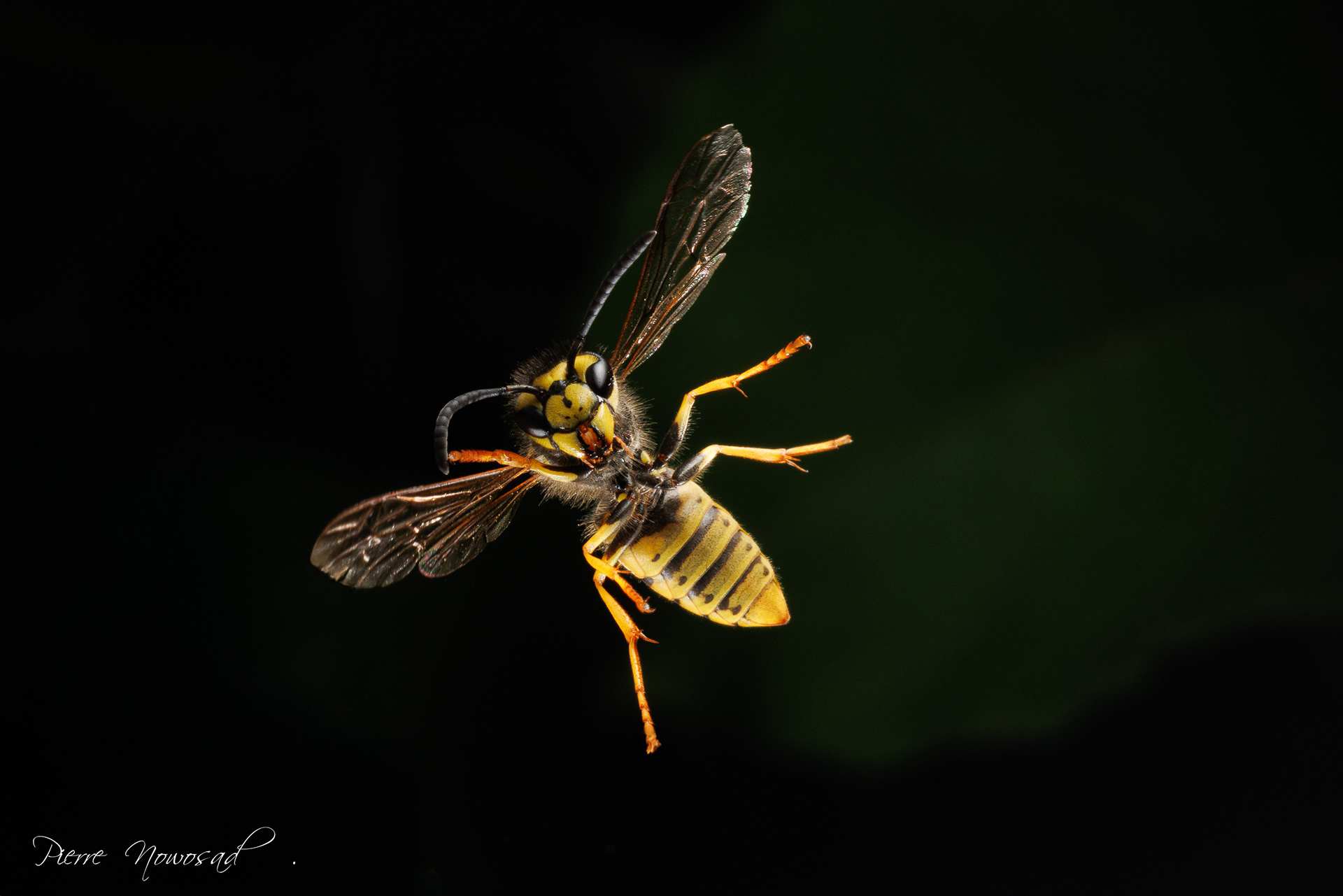
Welcome to Insects In Flight
Capturing insects in flight is one of the most challenging forms of nature photography. Every image on this website is created using a dedicated high-speed photography setup that combines precision timing, macro optics and specialized lighting.
My name is Pierre Nowosad, a Belgian nature photographer with a passion for revealing details that are invisible to the human eye. Using a Canon EOS R5 Mark II, a Cognisys StopShot trigger system and carefully positioned macro flashes, I photograph insects at the exact moment they fly through a predefined point in space.
The galleries on this website feature bees, hoverflies, dragonflies, butterflies, wasps and many other fascinating insects. Each photograph captures a unique fraction of a second, revealing wing movement, body position and behaviour that cannot be observed during normal flight.
Besides presenting my photographs, this website also explains the equipment, techniques and workflow used to create these images. Whether you are interested in macro photography, high-speed photography or simply enjoy the beauty of insects, I hope these galleries will inspire you to discover the remarkable world of insects in flight.
Welcome, and enjoy your visit.
Pierre Nowosad
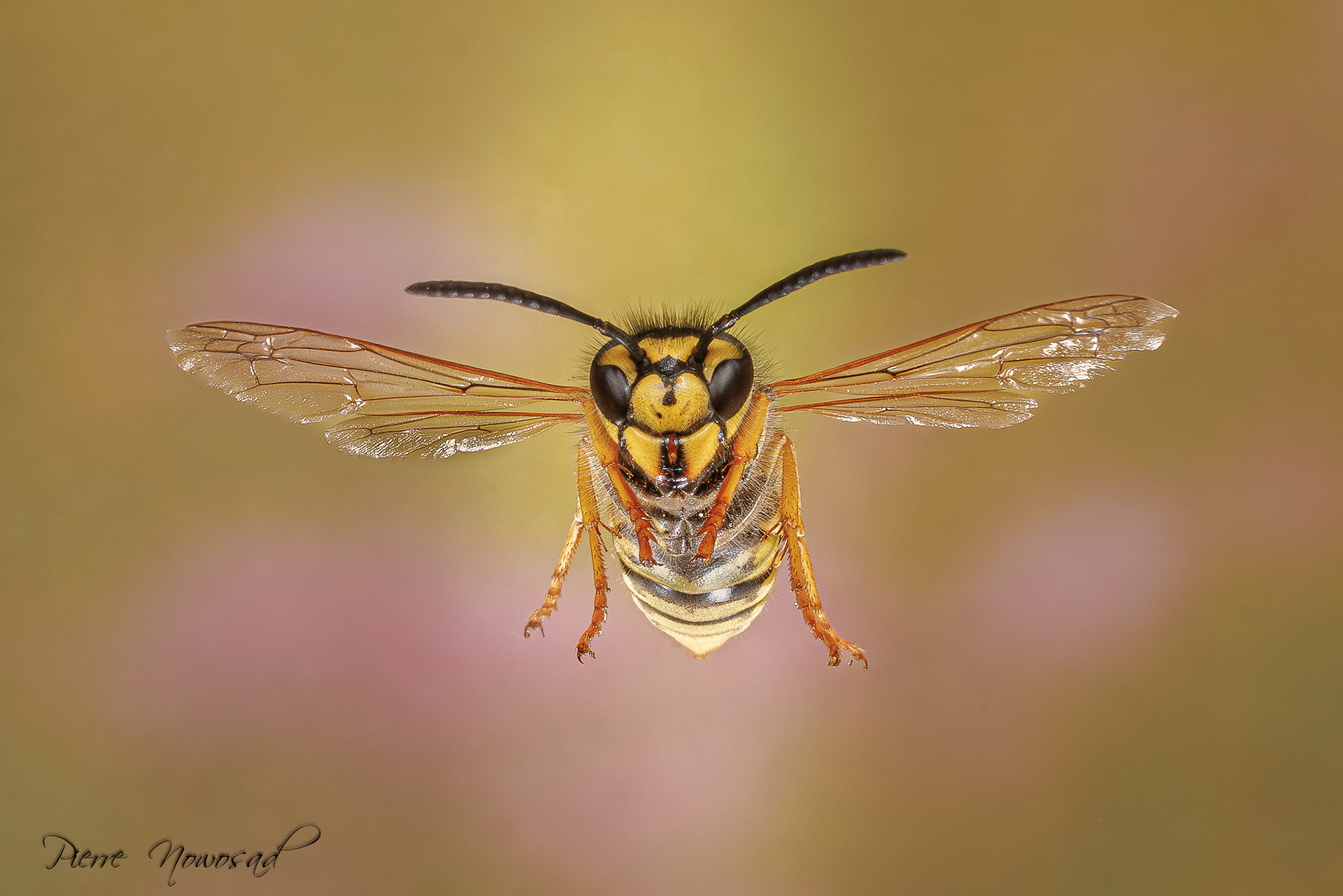
Introduction.
It is not about how long or short the shutter stays open, but the exact moment when it opens!
Photographing flying insects is a major challenge where various obstacles must be overcome. They are unpredictable in their flight patterns and speed. It is even more difficult than photographing birds in flight, so we are taking on the challenge! Bees and wasps are among the slightly less difficult species and are a good starting point for experimenting. The most common method is to try to follow the critters on a clear summer day with sunshine and using a 70-200 mm lens or a 100-500 mm lens at a shutter speed of 1/2000 to 1/4000, capturing them with or without the AF setting or tracking on "animal". Nowadays, there are cameras with "pre-shooting" or "pre-capture", where you capture a number of images in advance before you press the shutter. With this method, you can easily take thousands of photos in just an hour, from which, with a bit of luck, you can select a few that are good enough.
The second option, and my preference, quickly leans towards the professional method. Namely, a flight chamber with plexiglass that you can build yourself. Flashes, lasers, an external shutter (HSS - High Speed Shutter from COGNISYS), and a control box to which everything is connected and configured. The advantage of this is that you have far fewer redundant photos because you can align the lasers in "cross" and thus reduce the flight zone. The result is many more good, sharp photos due to the speed of the external shutter, which controls the 3 or 4 flashes with a time of approximately 5 to 10 milliseconds; this is while the response time of a modern system camera for shooting, depending on the camera brand, is 40 to 100 milliseconds! 1 - The camera shutter speed is usually 1/200 to 1/250 sec for flash synchronization.
The camera shutter has a shutter lag (delay between trigger and opening) of approximately 40–70 ms, depending on the camera and settings. An insect flying at 5 m/s covers about 25 cm in 50 ms. That is much too late if you want to photograph exactly when the insect flies through the laser beam.
The external high-speed shutter has a much shorter and more reproducible delay (typically less than 1 ms). This allows you to time the shot much more accurately. The flash duration of the flash unit itself vs. the camera. There is an important difference between the shutter speed of your camera and the actual burn time of the flash unit.
The camera (1/250s): This is simply the time the shutter remains open. The flash (1/128s): A reportage flash or macro flash flashes much faster than 1/250s. At full power, a flash often lasts around 1/1000s, but if you set the power manually (for example to 1/64 or 1/128 to 1/256 power), the flash duration becomes extremely short, between 1/10,000s and as much as 1/40,000s, or 0.01 to 0.04 milliseconds! In a dark room, the flash therefore determines the sharpness of the image, not the camera. This is the time that your shutter remains open to let light in; your curtain must open and the mechanical action kicks in (shutter lag). To set all this in motion, you get a delay of 40 to 100 milliseconds. At this speed, the insect has already moved 20 mm past your manual focus point!
2 - The external shutter: trigger (4 milliseconds)
An external shutter is mounted on the front of the lens and controlled via a laser and controller. This works much faster than the camera itself, even though it only goes around 1/250 shutter speed. BUT if you set your camera to BULB and the camera shutter is already open for a certain time, a signal is sent to the external shutter within 5 milliseconds upon a trigger, and this simultaneously controls the flashes that take the photo at 1/40000 sec. if your flash settings are set to 1/128 or 1/256! So the camera is open (BULB) and waits for a signal from the lasers that control the controller, HSS, and flashes! Conclusion: your camera is secondary here; it only captures the photo via the external shutter that allows the flash light, controlled by the controller. The advantage with (HSS) is that you can photograph outdoors in the shade during the day instead of in a dark, enclosed room to shield the light from the sensor when using bulb and without HSS.
Building the entire system was a challenge that took me 4 months to make everything myself without a plan or calculations: experimenting, testing, dismantling, starting over, and starting over yet again!! I view it as part of the photography hobby, and it gave me satisfaction to spend my time on it until the final result emerged, with the first beautiful photos I captured with the system coming to light!
Building the entire system was a challenge that took me 4 months to make everything myself without a plan or calculations: experimenting, testing, dismantling, starting over, and starting over yet again!! I view it as part of the photography hobby, and it gave me satisfaction to spend my time on it until the final result emerged, with the first beautiful photos I captured with the system coming to light!
Have fun experimenting!
Pierre Nowosad
Towards Cognisys equipment